Our tour this morning started with a visit to the hilltop Convent of Christ (the Convent is surrounded by the walls of the Castle of Tomar). The "Military Order of Christ" was established in 1318 (but the Knights Templar existed outside of Portugal prior), and those in the order were known as the "Knights Templar". This UNESCO site has some fascinating information on the convent, and as we all know, the Knights Templar have a very interesting (and I would also argue confusing as well) history. We were told that King John III changed the order to be a more traditional religious order (in the 1500s). The order was secularized in 1789, all religious orders were forced out of Portugal in 1834, and dissolved in 1910, when the monarchy ended. It was revived in 1917, as an Order of Merit, headed by the President of Portugal, as a decoration in recognition of outstanding services to the state.
Blog Post Categories
Monday, April 24, 2023
Tomar and Castelo de Vide
Friday, April 21, 2023
Porto, Take II
We had a morning tour of the area and were on the bus and ready to go at 8:30am. An overcast morning drive down Avenida Da Boavista (the longest avenue in Porto, and also the one on which our hotel is located) to where it ends at the Atlantic Ocean. The Boston Crew had walked there yesterday (it doesn't look far on a map, but it's a few miles there and back) and said the city park (Parque da Cidade) is lovely. From there we turned south and headed down Av. de Montevideu before a quick stop at Jardim do Passeio Alegre - best known toilets in Porto! Maria, our guide for the morning, was quite serious about that because, as it turns out, the toilets have Art Nouveau tiles inside (and no, you cannot use the restroom there for free, you must pay). The garden had some lovely fountains as well, but we didn't stay long enough for me to have a proper perusal.
![]() |
| Bathroom tiles |
Another rainy walk towards the southern side of the Duoro River, over Ponte de Louis I (Louis I Bridge was built by a student of Eiffel), and into VIlla Nova de Gaia.
Although only across the river, it's a completely different city and actually has a larger population than Porto. When in Port, you do a Port tasting. We headed to Burmester Winery to learn about Port making and then to try some. To make port they had wine spirits to fermenting wine which stops the fermentation process and keeps the sugars. The Duoro Valley is a demarcated wine region (much like the Champagne Valley in France) and is actually the first such region in the world (and therefore the oldest). The grapes are grown in the valley, harvested by hand, and then transported to Porto to be aged. They can use 100 different varieties of grapes to make port, but Burmester uses only 18. The white port was very sweet, hints of honey, and even the tawny port was sweet, but I still preferred the white.
A rainy walk back to our bus, and then we were deposited back at our hotel. A snack-lunch of tuna and crackers (my long-time readers will recognize my preferred travel snack), while drying out and waiting for the rain to end (by 4:30 it had stopped) gave me time to journal and upload photos before heading back out for the evening.
My fado performance for the evening was at Ideal Clube de Fado, where they advertise you can "Discover the most authentic tradition of classic Fado in an intimate concert with renowned Porto artists." It was highly recommended on the internet, and for good reason! As their website states,
"There are many ways to sing the Fado, but among our artists we cultivate a passion for the origins of this song, which was included in UNESCO’s lists of Intangible Cultural Heritage in 2011. At Ideal Clube de Fado, we believe that each concert is a live act of creation, a unique experience that is renewed every day and drinks from the inexhaustible source of this strange way of life that is to be Portuguese."
There article here attempts to explain the difficulty people have in defining fado (and what fado is not).
Thursday, April 9, 2026
Preparing for Spain
As many of you know, I'm off to Spain today! For a country that has been on my bucket list for the last 15 years you might be surprised I've not been there yet. And all I can say is that I've been waiting for a tour to go on sale, and it's just never been as low as I wanted it to be! Finally, after hearing over and over again on my tour of Portugal how much I would love Spain if I was enjoying Portugal (which I was enjoying), and after reading a fascinating book about Andalusia, I decided it was time. Sale or no sale, it was time to book a trip to Spain. The Gate1 Travel Single-Supplement sale came around last fall and when I saw that the fee (you have to pay extra to join tours when you're traveling alone, and they call it a "single supplement") for Spain was $1000 and that it was waived as part of the sale, I knew I had to take the leap (even if I paid full price for the tour).
To prepare for the trip I've been re-reading the above-mentioned book, Ornament of the World. The combination of things I learned in Portugal, and the things I learned about Jewish history from my tour of the POLIN museum in Poland, have certainly helped me keep the timeline and understand the context of the book better this second time around. It's incredibly fascinating how the author ties together the history and how events impacted the religions and cultures of the area.
Also, for the first time I'm trying out an app called TimeShifter which I read about in How to Win at Travel. I'm hoping it works and helps to mitigate (even eliminate) my jet-lag and make the tour much more enjoyable for me. That being said, it required that I be up at 3am this morning (after several days of earlier bedtimes and earlier wake-up times) and my flight doesn't leave until 5:30pm tonight! The plus side to that is that I did the majority of my packing, cleaned my house, mowed my lawn, and still had time to write this post before heading out.
Oh, and another first happened last night as I was checking in for my flight. It wanted me to pay $75 to check my bag, which was a surprise because the last time I flew to Europe I only paid $40! I did some searching and found out that the fee for checked bags to Europe is indeed $75 and now I had a dilemma. I had planned to check a bag, but hadn't really packed anything yet, and was the extra pair of shoes worth $75 EACH WAY? So, for this 15 day trip, I managed to pack in a carry-on. Will my feet hate me when I have to wear the same pair of shoes every single day? Maybe, but I'd rather spend my $150 on something else. If only my 18-year-old self, packing for a semester abroad in Italy, could see me now!
My apologies for the teaser, as there's no way I'll end up blogging on the tour (even if I end up not having jet lag), but it's always good to have something to look forward to! Ciao!
Wednesday, April 26, 2023
Lisbon, Cascais, & Sintra
![]() |
| Former convent that houses Parliament |
Our tour began with a drive just up the hill from our hotel to King Edward VII's Park where we enjoyed the view of the hills of Lisbon and out to the Tagus River (Rio Tejo). In 1903, King Edward VII of England came to Portugal to commemorate, and reaffirm, the political alliance between the two countries. Prior to that visit the 64 acre park was called Parque da Liberdade (Liberty Park). The huge statue (it's over 130ft tall) of Sebastião José de Carvalho e Melo, 1st Marquês de Pombal sits in the middle of the roundabout. He was a fascinating character and also the namesake of our hotel.
On All Saints Day (November ) in 1755, Lisbon experienced a devastating earthquake (Voltaire even wrote a poem about it). "The total number of persons killed included those who perished by drowning and in fires that burned throughout Lisbon for about six days following the shock." The Marquês de Pombal was a statesman, diplomat, and prime minister to King Joseph I, and following the disaster he took charge of the reconstruction. Amazingly, in less than a year the city was partially rebuilt and with the world's first earthquake-resistant buildings! He's also credited with creating the demarcated wine regions of Portugal (with the Douro Valley being the first in the world).
![]() |
| Calçada portuguesa pavement on Avenida da Liberdade |
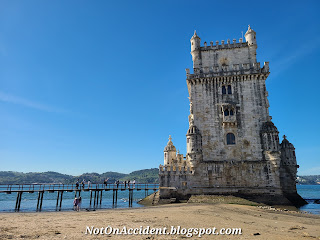
Our next stop was the lovely Belém Tower from the 16th century, a fortification that was used as the beginning point and end point of the voyages of the Portuguese explorers. It was also often used as a ceremonial gateway to Lisbon. The Knights Templar were very powerful and wealthy at that time, and they had a hand in the voyages and discoveries made. You can see some of their insignias on the fortress (Templars cross, nautical knot, rope motif, etc.).
On to the Padrão dos Descobrimentos (Monument to the Discoverers), a stunning work that commemorates the 500th anniversary of the death of Henry the Navigator (discoverer of the Azores, Madeira, and Cape Verde). It stands 170ft tall and "is made up of a group of sculptures that represent the prow of a caravel (a small sailing ship constructed by the Portuguese to explore the Atlantic Ocean). Leading the ship is Prince Henry the Navigator and behind him are many other great Portuguese discoverers", including Vasco de Gama, Magellan, and Henry's mother.
We didn't have much time left over for exploring Sintra, but what I saw of the town was lovely.
Back in Lisbon, and off on my own, I headed to the oldest bookstore in the world. I'll admit I had high hopes, but was rather disappointed with the Livraria Bertrand. Had I realized it's now a nationwide bookstore chain I might have lowered my expectations a bit. Either way, it was established in 1732 and is recognized with a Guinness World Record.

References:
https://www.britannica.com/event/Lisbon-earthquake-of-1755
https://www.lisbon.net/monument-discoveries
https://www.jeronimosmonasterytickets.com/history/
https://www.tasteatlas.com/travesseiros and https://www.tasteatlas.com/queijada
Thursday, April 27, 2023
Lisbon's Countryside Towns
Thursday was a tour of a few of the surrounding towns, with our first stop in the medieval town of Óbidos (pronounced 'o-bee-dosh' by Nélia). They formerly used windmills in this area to grind grain, so they are somewhat a symbol of the region, however, they must not sell well because they weren't to be found, in replica form, in most of the shops I visited. I've been searching, since Porto, for a pair of dangly earrings shaped like tiny azulejos. Unfortunately, it has been in vain thus far; every shop I've perused (in lightning fashion) has only a poor imitation of the tiles: a glazed dome over the tile pattern, partially obscuring the pattern so you'd never imagine it to be a tile from Portugal.
Anyway, the town has been well restored, so the exterior of the homes there still appear as they may have in the 1500's, and the city wall is still incredibly well intact. It was considered one of the Queen's towns for hundreds of years, so their taxes all went to her, and not to the King. As such, many of the Óbidos festivals reflect that heritage. Understandably, they have a huge Medieval festival each year (even the Portuguese attend), and they have a large chocolate festival. In this area they sell and, I assume, make Ginja, a sour-cherry liquor which they serve in chocolate cups. I popped my head into a few churches, but there was no real "tour" so we were free to wander. I struck out for the walls of the city to catch the views of the surrounding landscape (while quickly checking the numerous shops for the aforementioned earrings).
Back on the bus we headed north to the city of Alcobaça (pronounced Al-koo-baas-sa) to visit their monestary, also known as Santa Maria de Alcobaça Church. It's the first building in the country to be fully built in the Gothic style. in addition, it's the largest church Portugal, with over 100 meters from the door to the alter. Despite the Gothic inside, the exterior façade is in the Baroque style.
Construction was begun in 1178 by Cistercian monks and the church was consecrated in 1252. The other interesting aspect of the church is who was entombed there: King Pedro I and his lover, Inês de Castro. The story, as told by Nélia and what I've read online have similar narrations, but the exact timeline is still fuzzy for me. Either way, he was madly in love with her, claimed they had been married in secret (all before he was actually king), but his father, King Afonso, had her killed to prevent her family from influencing politics in Portugal and from becoming royalty (by extension) - the usual reasons for that time period, I guess. Their sarcophaguses were incredibly ornate. Sadly, many of the statues carved into them are now headless because of Napoleon's troops.
They believed that the Portuguese buried their kings with jewels (they don't, even though they had incredible wealth), so when the troops found none inside the sarcophaguses they thought the monks had been clever and hidden the jewels inside the statues carved into the outside (wrong again). The monastery was extensive and in it's heyday had at least 1,000 monks. Although it was a bit austere, it was a beautiful church, though enjoyed mainly by the monks. Since they didn't allow common-folk inside until the 18th century, that could explain its plain interior.
From there we headed east to Nazaré which was once known for their small, beautiful fishing boats used in the dangerous waters (there is a bad undertow).

The women dry the catch out in the sun on the beach to preserve it for times when the men can't go out and fish.
They still do some fishing today, not now the area is known for surfing -- especially the colossal waves out around the point that are stories-high. The area by the beach is extremely touristy, but one or two streets in it all appeared very residential -- no shops, just laundry drying in the warm spring wind.
We got back on the bus for the hour-and-a-half ride back to Lisbon and then had about an hour before our farewell drink and dinner. Because of the seat rotations on the bus I didn't get a chance to properly meet everyone on the tour, and within a few days most people stop wearing their name tags, so if you didn't catch a name by day 2 or 3 you'll have to ask. Anyway, I finally met a couple from Ohio that it turns out used to vacation in Australia quite frequently 30 years ago. Port Douglas and Palm Cove...lovely memories of those places, so it was almost as good as meeting someone from Western PA. We did get a group photo before heading to dinner, so that was a really nice memento. Dinner was tasty, but it was stifling hot in the restaurant that night. I bookended my trip with the Boston crew, rounding out their numbers for one final time. Oddly enough, it was the first time I could have sat elsewhere (there weren't exactly 42 seats saved), but my welcome dinner and every group dinner after had been with them, so it was only fitting. Overall, we had such a lovely crew that I can honestly say I could have spent another week with them all. Who knows, maybe we'll bump into each other on another Gate1 tour someday.


